
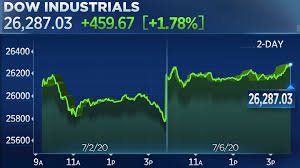
The Dow Jones Industrial Average (DJIA) remains one of the most influential indicators of global economic confidence. As a benchmark tracking 30 of the largest publicly traded U.S. companies, the Dow reflects shifts in corporate performance, consumer demand, and broader geopolitical sentiment. Investors and analysts continue to monitor its movements to understand market trends and evaluate future business cycles.
The index captures momentum across multiple sectors, including banking, technology, consumer goods, energy, and industrial manufacturing. With each update, the Dow provides an immediate snapshot of business strength, capital flows, and investor expectations. Understanding what drives this index allows traders to position themselves strategically in volatile economic conditions.
FintechZom delivers unbiased Dow Jones coverage for business leaders, institutional investors, analysts, and independent traders. Our objective is to provide clarity on market fluctuations, price signals, and the economic data influencing index performance.
What Is the Dow Jones Industrial Average?
The Dow Jones Industrial Average measures the performance of 30 elite, blue-chip companies listed on U.S. exchanges. Each company represents a significant share of its industry, forming a collective representation of American business activity. Unlike market-cap weighted indexes such as the S&P 500, the Dow is price-weighted, meaning higher-priced stocks have a greater influence on the index.
Seminal Dow Jones holdings include banking giants, major industrial firms, consumer brands, retail leaders, and multinational tech companies. Their earnings, stock volatility, and business performance contribute directly to index direction. When these companies face positive earnings surprises or forward guidance, the Dow generally trends higher.
Market participants use the Dow Jones to gauge investor appetite and business resilience. Long-term analysis of Dow performance reveals consistent patterns tied to commodity cycles, fiscal policy, inflation reports, and corporate balance sheet strength.
Economic Indicators That Influence Dow Jones Movement
Interest rate decisions by the Federal Reserve are among the strongest drivers of Dow volatility. Rising rates typically reduce borrowing capability for corporations and consumers, often weighing on index performance. Conversely, rate cuts can stimulate economic spending, supporting stock gains in business-driven sectors.
Inflation reports, including CPI and PPI data, play a central role in market expectations. High inflation leads investors to anticipate tighter monetary policy, impacting Dow components in manufacturing, retail, and finance. Stable or declining inflation supports business optimism and potential earnings growth.
Employment numbers, consumer confidence surveys, and GDP estimates all contribute to valuation sentiment. When U.S. labor markets strengthen and business expansion follows, Dow Jones sentiment improves. Weak employment data, declining manufacturing output, or falling productivity typically pressure the index.
Corporate Earnings and Dow Jones Performance
Quarterly earnings releases drive some of the largest intraday Dow swings. Analysts analyze revenue growth, net income, margin expansion, cost structure, and forward guidance. When companies exceed market expectations, the Dow often rallies strongly, particularly if multiple components report strong performance simultaneously.
Weak earnings, cautious forecasts, or restructuring announcements can send the index into retreat. Investors watch corporate strategy, supply chain stability, retail demand, technology investment, labor costs, and international expansion efforts. Each corporate decision impacts investor sentiment and long-term valuation assumptions.
For business readers, earnings season provides actionable insight — revealing sector momentum and identifying assets poised for future growth. FintechZom routinely provides earnings commentary, company breakdowns, and post-report performance reactions for Dow constituents.
Geopolitical Events and Dow Sensitivity
The Dow responds quickly to trade negotiations, regulatory changes, tariffs, international sanctions, and diplomatic conflict. Global supply chain disruptions often affect industrial manufacturing and consumer goods companies directly. Political risk increases volatility across multinationals relying on strong foreign demand.
Energy policy, commodity movements, and global transportation bottlenecks can also influence corporate margins and bottom-line profitability. When policymakers introduce favorable legislation, infrastructure spending bills, or cross-border agreements, Dow optimism typically strengthens.
Investors should watch central-bank announcements by global institutions, international lending activity, national budget discussions, and macroeconomic policy updates. Each headline has the potential to push Dow sentiment into a risk-on or risk-off direction.
Dow Jones vs. Other Major Indexes
Compared to the S&P 500, the Dow is more concentrated with a focused group of long-established companies. While the Nasdaq indexes tech-heavy firms, the Dow tracks broader industrial and commercial business sectors. This creates natural diversification for market participants.
The Dow remains a preferred index for economists, business analysts, and financial media coverage. Its historical data makes trend mapping straightforward, revealing multi-decade cycles and predictable recovery patterns. Long-term investors continue to treat Dow exposure as a strategic defensive allocation.
Professional traders often track correlation between Dow Jones futures, Treasury yields, oil prices, VIX volatility index, and U.S. dollar strength. These correlations signal risk appetite, capital allocation strategy, and institutional positioning.
Long-Term Investment Outlook on the Dow Jones
Business expansion, technological integration, and corporate restructuring continue to support long-term Dow growth. Despite periodic volatility and recession risk, the Dow historically recovers faster than broader benchmarks. Strong cash flow, dividend stability, and consistent consumer demand reinforce resilience.
Global demand for American manufactured goods, retail brands, technology innovation, and financial services continues to support index value. Investors remain focused on business fundamentals, competitive advantage, and leadership strategy among Dow heavyweights.
Future growth will likely come from emerging technologies, infrastructure development, digital transformation, industrial robotics, energy transition initiatives, and business sustainability investments.
FintechZom Dow Jones Insights — Final Thoughts
Monitoring Dow Jones performance offers direct economic intelligence for business leaders and investors. It highlights shifts in monetary policy, corporate earnings strength, consumer confidence, and international trade exposure. Every movement provides valuable clues about economic direction and market sentiment.
FintechZom remains committed to real-time data reporting, expert commentary, sector analysis, and business news updates. Our ongoing Dow coverage ensures readers understand the core forces shaping the world’s most recognizable stock market index.
For more market analysis, follow FintechZom’s coverage of U.S. equities, live index performance, global market news, and business intelligence updates.